As the Bainbridge Review reported, the Bainbridge Island Planning Commission once sat through an evening that tells you almost everything about how waterfront ownership actually works here. Two families on Blakely Harbor, on opposite sides of the water, had each applied to build a private dock. Neither had done anything unusual. One family, the Bottles on Seaborn Road, proposed a low-profile floating structure designed with input from state marine ecology experts, the kind of dock a planner might call the most environmentally benign option available. City staff recommended approval. The neighbors mostly supported it.
The commission voted against both applications anyway, unanimously, saying the harbor's four existing docks were enough and that the community valued keeping Blakely Harbor close to untouched. A longtime resident named Robert Smith rowed in that night to make his case in person. He told the commission the previous owners of the property in question would have been furious at the idea of a new dock going in.
They "would curl your hair," he said, according to the Bainbridge Review.
That is an important distinction in Bainbridge waterfront ownership. You can own the house, the lawn, and even the beach in front of it, and still not have the right to put a dock on that water. Ownership and permission are two separate questions on this island, and both are worth checking in a waterfront transaction.
The Word "Waterfront" Describes a View, Not a Boundary
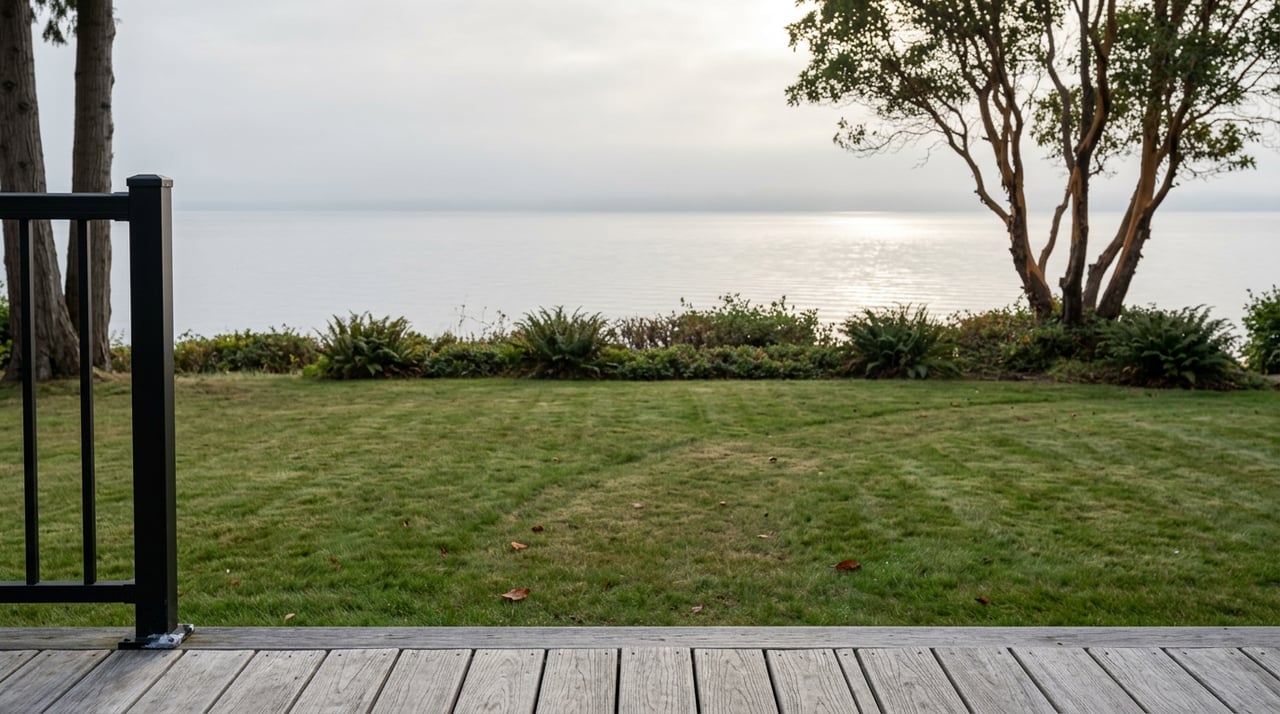
A waterfront listing alone does not answer whether you own down to the water.
The reason is historical and parcel-specific. Washington became a state in 1889. Two houses on the same stretch of shoreline, built the same year and looking identical from a boat, can carry entirely different answers to the question of who owns the beach in front of them.
The Rulebook Is Thicker Here Than Almost Anywhere Else in Kitsap
Even when tideland ownership is clear, using that shoreline is governed by the city's Shoreline Master Program, and Bainbridge's version is unusually dense. During one legal challenge to the program, an attorney representing a group of shoreline homeowners pointed out that San Juan and Island counties, both known for strict shoreline rules of their own, run about 200 pages each. Poulsbo's shoreline program runs about 50. Bainbridge's ran to roughly 400 pages, and the same attorney said then-Governor Jay Inslee, who lives on the island, had told him directly that Bainbridge's shoreline rules were the strictest in the state.
The Bainbridge Island Review reported that the Kitsap County Association of Realtors challenged an earlier round of the city's environmental rules on similar grounds, arguing the ordinance was so broad that nearly any development or land use activity on the island would trigger a critical area permit. The Growth Management Hearings Board upheld the city's rules anyway. The point isn't who was right. It's that this level of dispute over shoreline regulation is normal here in a way it simply isn't in neighboring markets, and it shapes how long anything near the water takes to approve.
Concretely, the shoreline program reaches 200 feet landward of the ordinary high water mark and covers the marine waters out to the midline of Puget Sound, Port Madison, Agate Pass, Port Orchard, and Rich Passage. It does not apply to Bainbridge's freshwater lakes and streams, which is a distinction worth knowing if a property you're considering sits near fresh water instead of salt water, since the permitting path is different.
What This Actually Costs You in Time
For a buyer or seller, the practical question isn't the philosophy of the Shoreline Management Act. It's whether the dock, bulkhead, or landscaping plan you're picturing needs a permit, and how long that takes.
The City of Bainbridge Island says a new dock on Bainbridge requires a shoreline permit. Modifying, repairing, or replacing an existing dock generally requires a shoreline exemption instead, which is a lighter process but still a process.
Landscaping isn't automatically exempt either. King 5 reported that Bainbridge homeowner and real estate agent Doug Nelson sued the city over its Native Vegetation Zone rules, which required him to plant only native vegetation along his beachfront yard and barred him from putting in a lawn, wide paths, or even a bench in most of that space. His argument, through attorney Dennis Reynolds, was that the rule went further than protecting the shoreline and effectively took away his ability to use his own yard. Whatever your view on that case, it illustrates something useful for a buyer: what you plan to do with a waterfront yard after closing may be constrained well before you get near the water itself.
The Road End Isn't Always Yours Either
Beach access assumptions extend past the property line, too. In one case, neighbors near a road end had gated it and treated it as private for roughly a decade, until the state Court of Appeals upheld a ruling that the public had a right to use it, based on its history as a ferry landing that had never formally been given up. If part of a property's appeal is a nearby access point to the water, it's worth confirming that access is actually private before it becomes part of the price.
Before You List or Write an Offer
A few steps make the difference between finding these issues in escrow and finding them after closing.
- Pull the full legal description and chain of title, not just the plat map, and look specifically for a tideland conveyance or a reservation to the state.
- Ask whether an existing dock has a current shoreline permit or exemption on file, and whether it's transferable to a new owner.
- If tidelands are state-owned, confirm whether a Department of Natural Resources aquatic lands lease is required or already in place for any dock or float.
- Check whether the parcel falls inside a Native Vegetation Zone before assuming a lawn, patio, or deck expansion is straightforward.
- If beach access depends on a nearby road end or path, verify in writing that it's a private easement and not a historically public access point.
- Build permitting timelines into your offer, not just your renovation budget. A shoreline permit process here can run longer than buyers from off-island expect.
Frequently Asked Questions
Can I build a new dock if my neighbors already have one? Existing docks on a stretch of shoreline don't guarantee approval for a new one. The Blakely Harbor case shows the city can and has denied new dock applications even with strong neighbor support and a low-impact design.
Do these shoreline rules apply if my property is on a lake instead of Puget Sound? No. Bainbridge's Shoreline Master Program applies to the marine shorelines named in the code and does not cover the island's freshwater lakes or streams, which follow a different set of rules.
What's the fastest way to find out what applies to a specific property? Start with the chain of title and a conversation with the city's Planning Division before you assume anything about docks, bulkheads, or yard use. What applied to the house next door may not apply to yours.
Waterfront ownership on Bainbridge rewards buyers and sellers who ask the second question, not just the first. If you're weighing a waterfront purchase or preparing to list one, Mark Middleton Real Estate can walk the title history and permitting picture with you before it becomes a surprise in escrow. Request a private consultation to start with the facts specific to your property.
This article is general information, not legal, tax or financial advice. Consult a qualified professional about your situation.